Epiphany 1, 2026
The First Sunday after the Epiphany
Luke 2:41-52
January 11, 2026
God’s Word describes what people will be like at the end of the world:
Know this, that in the last days perilous times will come: For men will be lovers of themselves, lovers of money, boasters, proud, blasphemers, disobedient to parents, unthankful, unholy, unloving, unforgiving, slanderers, without self-control, brutal, despisers of good, traitors, headstrong, hau ghty, lovers of pleasure rather than lovers of God, having a form of godliness but denying its power. And from such people turn away! [2 Tim 3.1-5]
“Disobedient to parents.” Evangelical Christians sometimes get nervous talking about obedience. After all, we’re saved by grace alone, so any talk about obedience might confuse people.
But God’s Word is not confusing. It is clear. We need no pope or patriarch to give a hidden meaning, or explain away the clear words. God calls us to obedience. Today’s Gospel shows us an obedient Jesus as a child. “Then He went down with them and came to Nazareth, and was subject to them.”
Jesus is the obedient One. And we are called to imitate Him.
Christmas Eve at Immanuel always begins by singing Once in Royal David’s City. But in our 1982 hymnal, a stanza was missing. Thanks be to God, it was put back in our current hymnal. It starts like this: “For He is our childhood’s pattern.” Children are to imitate Jesus; He obeyed Joseph and Mary, and He’s our pattern. But we’re still missing a stanza! There’s one more the church doesn’t seem ready to sing. It goes like this:
And through all His wondrous childhood
He would honour and obey,
Love and watch the lowly maiden,
In whose gentle arms He lay:
Christian children all must be
Mild, obedient, good as He.
The speculation is that such words are a little too on-the-nose for a modern audience. Perhaps modernity is in the shape it’s in because we stopped saying things like “children should be obedient.”
Children won’t be truly obedient unless we guide them to what is true. This means that just as children should imitate God the Son, so fathers should imitate God the Father. How does that happen? By finding the elusive balance between discipline and mercy. Here’s what God’s Word tells children and parents, in Eph 6:1-4:
Children, obey your parents in the Lord, for this is right. “Honor your father and mother,” which is the first commandment with promise: “that it may be well with you and you may live long on the earth.”
And you, fathers, do not provoke your children to wrath, but bring them up in the training and admonition of the Lord.
What’s said of fathers here applies to mothers as well – the fourth commandment makes that clear – but the father has the particular duty to govern his household. So what’s going on with this charge to “not provoke your children to wrath”? The scholar Thomas Winger puts it this way:
As the husband was exhorted to exercise his headship with sacrificial love (Eph 5:25), so now the father is warned not to abuse his authority through excessively severe discipline, partiality, unreasonableness, or unjust condemnation; he is to exercise his fatherhood as God does. He is to treat his children not as property but as fellow members of the body of Christ. [Ephesians, 662]
Your job as Christian parents—and our job together as a church—is to form our children as disciples of Jesus. Each section of the Small Catechism begins, “As the head of the family should teach it in a simple way to his household.” Luther didn’t make this up. He got it, like he got all of his teaching, from the Bible. Here’s what Moses says in Deuteronomy 6:6-7:
These words which I command you today shall be in your heart. You shall teach them diligently to your children, and shall talk of them when you sit in your house, when you walk by the way, when you lie down, and when you rise up.
He tells us to go on walks with our kids, talk to them about the faith, and teach them and pray with them when we get up, when we go to bed, and at mealtimes too. Like so many other things, it’s a transfer of information. But it’s never just about memorizing; we show them by example that we love reading and listening to God’s Word, we love going to church, we trust in God even when times are tough, and we are quick to forgive.
St. John Chrysostom, in his treatise On Vainglory and the Right Way for Parents to Bring Up Their Children says the first duty of parents is to teach them God’s Word:
We are so concerned with our children’s schooling [and worldly success]; if only we were equally zealous in bringing them up in the discipline and instruction of the Lord… This, then, is our task: to educate both ourselves and our children in godliness; otherwise what answer will we have before Christ’s judgment-seat?
Discipline and disciple come from the same root. If you love your children, you will discipline them. “He who spares his rod hates his son, But he who loves him disciplines him promptly” [Prov 13.24]. If you love your children, you will discipline them, which is to say, you will disciple them. Our individual goal is to finish the race as a faithful disciple of Jesus. Our corporate goal is to help the whole church do that. The race is a relay, where we pass the baton. We do whatever it takes to help all the children of parish stay on the course. Your generous offerings help make sure Immanuel continues to do this for generations to come.
This also means we have to keep evil things away from our children’s minds. St. Basil the Great, the fourth-century Cappadocian Father, put it this way:
Young people must be made to distinguish between helpful and injurious knowledge, keeping clearly in mind that Christian’s purpose in life. So, like an athlete or the musician, they must bend every energy to one task, the winning of the heavenly crown.
Do you want your children to gain injurious knowledge? Give them a smartphone. You may as well hand them a bottle of booze and some narcotics, or a loaded weapon. These things will destroy your children’s bodies, but the internet will kill their souls, without the proper discernment of how to avoid evil.
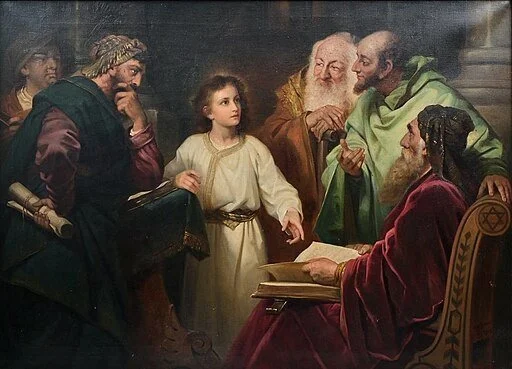
It is to destroy evil that the Lord Jesus came in the flesh. In the mystery of His humiliation, He goes to the temple and talks with the teachers there. What did they discuss? Did He ask them about the serpent Moses fashioned and put on the pole, foreshadowing the cross? Did He ask about the exodus from Egypt, and think about His own early childhood in Egypt hiding from Herod? Did He ask about the sacrifice of Isaac, when Abraham took him up the mountain, and said God Himself would provide the lamb?
Jesus is that Lamb. He is the obedient Son. At twelve, He is already thinking of how He must be about His Father’s business. And yet He obeys His earthly father Joseph, and Mary. He fulfills the Fourth Commandment, and all the commandments, where we have stumbled and failed. He is our childhood’s pattern, and He is our pattern in adulthood too, where He patiently bears what the Father gives Him.
Have you been a disobedient child? The Lord forgives you. Have you been an imperfect parent? The Lord forgives you. And today He sends us out to shape again our lives according to His pattern. +INJ+