The Confession of Saint Peter 2026
The Confession of St. Peter
St. Mark 8.27—9.1
January 18, 2026
+INJ+
On their journey up from Egypt, Abraham and his nephew Lot need to separate. Their flocks have grown too large to pasture in the same area. So Abraham offers Lot first choice. Lot chooses the greener pasture.
It’s what we all wish for, right? The greener pasture, the bigger house, the better job.
But the better things come with a cost. It’s a cost that imperils the soul. This is hinted at in Genesis 13, when Lot makes his choice.
And Lot lifted his eyes and saw all the plain of Jordan, that it was well watered everywhere (before the LORD destroyed Sodom and Gomorrah) like the garden of the LORD, like the land of Egypt as you go toward Zoar. Then Lot chose for himself all the plain of Jordan, and Lot journeyed east. And they separated from each other. Abram dwelt in the land of Canaan, and Lot dwelt in the cities of the plain and pitched his tent even as far as Sodom. But the men of Sodom were exceedingly wicked and sinful against the LORD. [vv10-13]
Lot chooses the prime spot for growth: plenteous water; land that looks like the primordial paradise. But there are two mistakes Lot makes with his choice. He is moving in the direction away from the promised land. And, he chooses to dwell in Sodom. It’s a city known for its great evil. But the money is too good to pass up, Lot thinks. He goes to where they practice sodomy, and moves there. Later, Abraham has to bring his army to rescue him. But Lot’s wife fell in love with the city, and it destroyed her. Lot’s daughters, too, become profoundly corrupt.
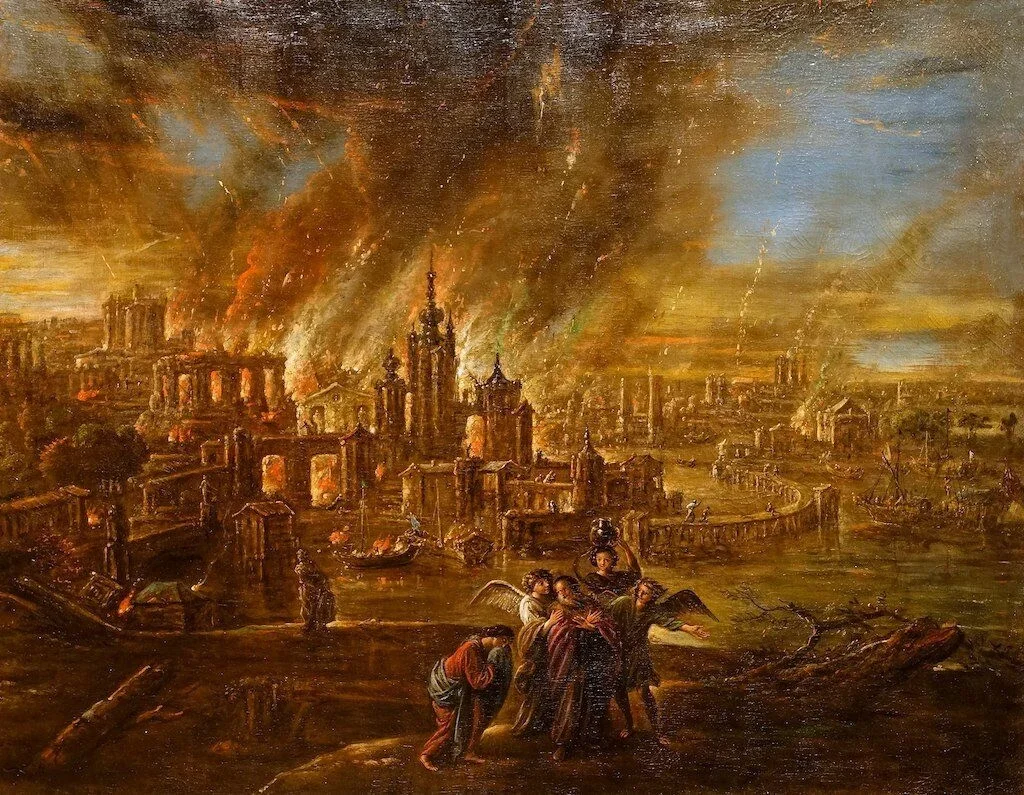
So Lot chooses Sodom, and moves there. “Then Abram,” we’re told, “moved his tent, and went and dwelt by the terebinth trees of Mamre, which are in Hebron, and built an altar there to the LORD.” Lot goes to Sodom, Abram builds a church.
Those are the choices. The greener pasture isn’t.
It’s this way with churches, too. When things get tough, it’s tempting to go where there are better programs, bigger crowds, and teachings that tickle the ears.
Churches with dramatic claims to antiquity or authority sometimes beckon. The ancient churches of Rome and Constantinople greatly appeal to some. Why? In many churches the worship is unstable, changing with every new hit song. Doctrines change as the culture shifts. Voting becomes the highest sacrament. In such an environment, people crave stability, order, tradition.
But the cure is worse than the disease. For both Rome and the East, it’s the continuity of the institution that ultimately matters. When you break it down, these churches are defined by their bureaucracy and their geography.
But the one, holy, catholic and apostolic church is not founded upon a pope. The one, holy, catholic and apostolic church is not founded upon patriarchs. It is not founded on a slavish devotion to liturgy. It is not founded on an institution or a bureaucracy or a peculiar form of church government. The one, holy, catholic and apostolic church is founded on a confession.
Today is the festival of the Confession of Saint Peter. The Church is not founded on the man Peter. The Church is not founded on the office of Peter. The Lord Jesus established no such thing. Everything rests on the words Peter gives in answer to Jesus’ question, “Who do you say that I am?” Peter confessed, “You are the Christ.”
Every one of us must answer that same question: Who do you say Jesus is? To be a Christian is to answer as Peter did: “You are the Christ.” That is the confession that binds us together. That is the truth that unifies the one, holy, catholic and apostolic church. Jesus is the Christ, the anointed One. Jesus is the incarnate God. Jesus redeems us from sin, death, and hell.
That confession will cost you. At the very least, it costs you time: time to come to church, time to pray, time to read your Bible. It costs you money, the generous and sacrificial percent you use to support Christ’s church. It can cost you your reputation. It can cost you the enjoyments everyone else seems to have who chooses Sodom over the altar of God.
And for some, it costs their life.
Today, and each new day, the choice of Lot and Abraham is upon us, the choice of Peter and Judas. The green pasture, or the promised Word? Confess Jesus, or sell out for thirty pieces of silver?
Today, with Peter and all the saints, we are called to choose the good confession: “You, Jesus, are the Christ. If I gain the world, but lose You, I have nothing. If I die, but have You, I have everything. In Your name alone, Jesus, is Life. In Your name alone is salvation.”
Having this Jesus, this confession, this life, we reject the choice of Sodom. We reject the seemingly greener pastures that involve compromise. We reject the seemingly greener pastures that involve friendship with the world. We reject the choice of Sodom, and place ourselves entirely in the hands of God.
We confess Jesus, come what may. We take up our cross and follow Him.
By ourselves, we don’t have the strength for it. But Holy Scripture today gives us this joyful news: "His divine power has granted to us all things that pertain to life and godliness." It is a gift: “His divine power has granted.” That is the heart of the gospel – a free gift.
Jesus is our confession. In Him will we live, in Him will we die, and His shall we be forever. +INJ+