Palm Sunday 2026
Palmarum
March 29, 2026
St. Matthew 27:51
It was June 1994. I was in Baltimore for a “summer vicarage,” an internship program for future pastors. My supervisor sent me to the hospital to visit someone. I was 23. I got on the elevator, pretty unsure of myself. A kindly old black man got on with me, and as the door closed he said, “Hello, father! You a young father, ain’t you?!” (It was nice while it lasted!)
In public, people call me father all the time. I don’t mind. The preaching office is a fatherly role. It’s not used frequently in the NT. The men the Apostles appointed are called most often presbyters (or elders); you also have overseer (bishop), minister, steward, ruler, and shepherd (which is what pastor means).
But the NT never uses priest for the office Jesus instituted. The only priesthood Jesus establishes is the collective, royal priesthood of all the baptized. St. Peter writes to the whole church: “You are a chosen generation, a royal priesthood, a holy nation, His own special people, that you may proclaim the praises of Him who called you out of darkness into His marvelous light” [1 Pt 2.9].
A church that has special, ordained “priests” denies the pure Gospel. That’s because in the NT, Jesus is the priest. Jesus is the priest.
His great priestly act is His self-sacrifice. The cross is the altar. Jesus is both priest and victim, offering and the offeror.
That truth is visually enacted immediately upon the death of Jesus: “Then, behold, the veil of the temple was torn in two from top to bottom.” What is this veil? Here’s how the LORD commanded Moses to make it:
“You shall make a veil woven of blue, purple, and scarlet thread, and fine woven linen. It shall be woven with an artistic design of cherubim. You shall hang it upon the four pillars of acacia wood overlaid with gold. Their hooks shall be gold, upon four sockets of silver. And you shall hang the veil from the clasps. Then you shall bring the ark of the Testimony in there, behind the veil. The veil shall be a divider for you between the holy place and the Most Holy.” [Ex 26.31-33]
To go beyond the veil was prohibited. Lev. 16.2: “And the LORD said to Moses: ‘Tell Aaron your brother not to come at just any time into the Holy Place inside the veil, before the mercy seat which is on the ark, lest he die; for I will appear in the cloud above the mercy seat.’” So the veil guards access to God’s presence. Once a year, on the Day of Atonement, the high priest could enter. He must ritually wash, and bring in a censer “full of burning coals,” taken from the fire on the altar. The incense was to be in thick clouds, covering the mercy seat (the golden covering of the ark of the covenant). After the incense, he then sprinkled blood from the sin offering for himself, a bull; then the blood of another bull, this one as a sin offering for the people. The LORD described what this did: the high priest is making atonement for himself, and atonement for the people. This is done annually. Which is to say, there was a perpetual need for atonement. Every year, the washing, the incense, the sacrifices continue. And every day throughout the year, a lamb, every evening, every morning. Day after day, sabbath after sabbath, year upon year. Sin. Blood. Death. Atonement.
But this day, this death, this blood, this Jesus brings it to an end. It. Is. Finished. Jesus is the atonement. Jesus is the last, final, great High Priest. In Him, everything changes for God’s people. Here’s how:
In the Bible, the term bold is used liturgically. It denotes access, the right to be somewhere or do something. Only the High Priest would be bold to enter beyond the veil, and then only with the incense and the blood. The tearing of the veil imparts that boldness, the right of access, the right of entry, to all those washed in the blood of Jesus. God’s Word tells us how the death of Jesus transforms the priesthood:
We have been sanctified through the offering of the body of Jesus Christ once for all.
And every priest stands ministering daily and offering repeatedly the same sacrifices, which can never take away sins. But this Man, after He had offered one sacrifice for sins forever, sat down at the right hand of God, from that time waiting till His enemies are made His footstool. For by one offering He has perfected forever those who are being sanctified.
But the Holy Spirit also witnesses to us; for after He had said before,
“This is the covenant that I will make with them after those days, says the LORD: I will put My laws into their hearts, and in their minds I will write them,” then He adds, “Their sins and their lawless deeds I will remember no more.” Now where there is remission of these, there is no longer an offering for sin.
Therefore, brethren, having boldness to enter the Holiest by the blood of Jesus, by a new and living way which He consecrated for us, through the veil, that is, His flesh, and having a High Priest over the house of God, let us draw near with a true heart in full assurance of faith, having our hearts sprinkled from an evil conscience and our bodies washed with pure water. [Heb 10.10-22]
God’s Word tells us that the veil is Christ’s flesh. When Jesus dies, His flesh torn by whips and thorns and nails, the once-for-all Day of Atonement is concluded.
Don’t let anyone drag you back to a religion where you need a priest to offer sacrifices for you, as though what Jesus did is insufficient. Your sins are pardoned. What gets distributed at the Supper is that sacrifice. Pastors are not priests, but messengers, announcing and delivering the sacrifice as a perpetual feast.
Now this doesn’t mean there are no sacrifices for us disciples of Jesus. There are no sacrifices to take away sin. But we do offer our bodies as living sacrifices (Rom 12.1), meaning that everything done in the body is to the glory of God. Sometimes this is called “mortification,” that is, a dying. Our bodies have desires. Because of the fall, the desires are disordered. Food, drink, the marriage bed, and so many other things can end up ruling us. We must fight that, mortifying, killing the carnal desires.
Other sacrifices disciples of Jesus offer include the sacrifice of praise – taking time on the Lord’s Day, and throughout the week, to confess sins, listen to God’s Word, and give Him thanks. Our money is a sacrifice, as we give it away to support the church, and missions, and do works of mercy.
But all these are responses. Being made holy by the sacrifice of Jesus, we strive to be what He calls us. This week we watch, wait, and receive the sacrifice of Jesus.
He is your Priest.
He is your sacrifice.
We have an advocate with the Father.
Jesus is the propitiation for our sin.
The veil has been torn.
Jesus is your Priest.
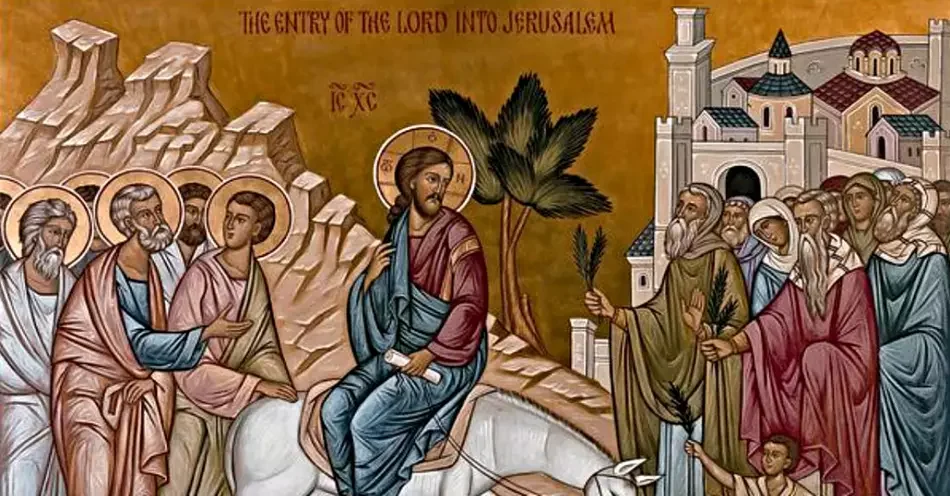
He entered Jerusalem for you.
You enter the new Jerusalem, the Kingdom of God, by Him.
+INJ+