Trinity 10, 2026
The Tenth Sunday after Trinity
August 9, 2026
St. Luke 19:41-48
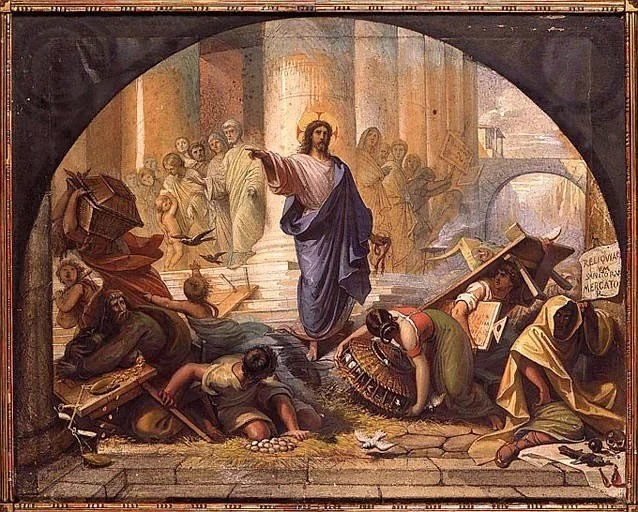
A little insertion crept into some manuscripts of Luke’s Gospel. Jesus goes into the temple and drives out those who are selling animals. The men who copied manuscripts of the Scriptures did a very good job. But every once in awhile there would be a little change. Sometimes it would be a spelling adjustment, or a grammatical change. Other times a sleepy monk might skip a word, or a line.
These little things are very easy to spot. We have over two thousand manuscripts containing Luke’s Gospel, so finding the original text is quite easy. Other times, you get a little change creeping in presumably to fit the usual patterns of speech. You can see that happening in today’s reading from Luke. Jesus goes into the temple and He begins “to drive out those who sold.” But that doesn’t sound quite right. So somebody added “those who bought.” Jesus begins “to drive out those who bought and sold.” And probably everyone did start running when the tables started flipping.
But the original reading is really important to figure out what is going on. It’s not the buyers, but the sellers, that upset Jesus.
This event takes place immediately after the triumphal entry on Palm Sunday. People are going to Jerusalem for Passover. And when you go to Jerusalem, you go to the temple. And when you go to the temple, you sacrifice. You need an animal. But if you live far away, like up in Galilee, it’s a hassle to bring animals along. Just buy one when you get there.
I quit following professional sports some years ago. And I think the last time I went to a movie was 2012. It’s just not worth it anymore. But I don’t think this has changed: food and beverage is sold at obscene prices.
That’s what’s happening in the outer precincts of the temple. Matthew and Mark give us a little more detail: it’s the money changers that particularly incurred our Lord’s wrath. You couldn’t use your regular money there. No, you needed a special shekel just for temple purchases. The Roman money would profane the sacrifice. And just like at TravelEx, or if you use the ATM in a foreign country, the bankers are making a profit when you exchange currency. In this case, just like at the movie theatre, the markup is way beyond market prices.
That’s why Jesus says they’ve made God’s House a “den of thieves.” The problem isn’t the selling. It’s the abuse.
It isn’t a new problem. In 1 Samuel 2, we read, “Now the sons of Eli were corrupt [NKJ] / worthless men [ESV].” Their custom “was that when any man offered sacrifice, the priest’s servant would come, while the meat was boiling, with a three-pronged fork in his hand, and he would thrust it into the pan or kettle or cauldron or pot. All that the fork brought up the priest would take for himself” [vv13f]. When the people would protest that the fat portion must be burned, the priest would say, “‘No, you must give it now, and if not, I will take it by force.’ Thus the sin of the young men was very great in the sight of the LORD, for the men treated the offering of the LORD with contempt” [vv16f]. If you read the whole thing, you’ll see there are other sins not fit for the ears of the little ones among us.
If you read through Acts, you’ll find a man wanting the gift of the Spirit in order to make money. And you’ll find the makers and sellers of idols starting riots when people stop buying the tokens of false gods.
In many ways, the controversy surrounding the forgiveness of sins in the sixteenth century was driven by money. Pope Leo needed money to pay off the loan he had with the Fuggers, a prominent banking family. The indulgences he put up for sale were to help with that loan, along with completing the construction of St. Peter’s in Rome. Charles V was getting a cut of the indulgence money to fund war with the Turks. When Luther preaches that you cannot buy forgiveness, the flow of German money to Italy dries up. Money has a tendency to corrupt theology.
I hadn’t been a pastor for very long before a woman asked me a question that flabbergasted me. She’d just had a baby, and we were scheduling the baptism. “How much does it cost?” she asks. “What do you mean?” “What’s the fee for the Baptism?” “Fee? There is no fee.” In the church she grew up in, there was a fee. I had no idea. It’s not for sale.
But if we did charge a fee, how much should it be? Would you shop around, see if you could get a discount baptism? We could put a little kiosk at the font, and then I’d pressure you into giving a 25% tip. It’s both humorous and grotesque to contemplate.
People still ask me that question, about baptisms, weddings, and funerals. How much does it cost? The truth is, you can’t afford it.
The money changers that Jesus yells at, the sellers of doves whose tables He flips over, the priest who charges a fee for a baptism – they’ve turned what is invaluable into a commodity. In a way, they’re charging too little, because they’ve stopped seeing the true value. You cannot buy a baptism. You cannot purchase peace.
Paradoxically, this is why you need to give more money to the church, not less. You need to give until it hurts – not hurts the budget you’ve created, but until it hurts the idol you’ve made out of your finances. What afflicts us all is the idea that if I just have enough money, I can secure my future. I need enough to pay my mortgage, get the car I want, get my burritos DoorDashed, and take a nice vacation every year. Oh, and there’s school tuition, seventeen streaming services, and overpriced beer at the baseball game.
To us today, Jesus says what He said to Jerusalem: ‘You don’t know the things that make for your peace.’
So ask yourself the question we heard in last week’s Gospel, the parable of the unjust steward: “How much do you owe?” What will you give, in exchange for your soul? In the parable of the unmerciful servant in Mt. 18, the man owes an impossible debt, and yet he strangles a man with a small debt, snarling, “Pay me what you owe!”
Sometimes we sing Ps. 116 as the offertory. In it is a rhetorical question: “What shall I render to the Lord for all His benefits to me?” The answer is, there’s nothing I can give that will suffice. So we resolve to offer instead the sacrifice of thanksgiving, then take up the cup of salvation.
What’s happening as Jesus cleanses the temple is that the costliest sacrifice has entered the city and ascended the temple mount. He will offer Himself. That’s what the baptism costs. That’s the price of the offering.
Look, we need money. We’ve got to fix the roof, we need new AC, and you’re supposed to take care of the pastors. The Bible says so. But don’t do it because you think you’re buying salvation. You can’t. You don’t have enough money for that.
But you do have money to keep the church in this place strong, and help others receive God’s gifts. And you do have more money than you need. Let go of your attachment to it. Seek the higher things. Forgive your enemies. Love your wife. Submit to your husband. Obey your parents. Nurture your children. Read the Bible. Be at peace, for your sins are absolved. How much do you owe? Nothing. Your bill has been taken care of by the man at the table over there.
+INJ+