The Sixteenth Sunday after Trinity 2025
1 Kings 17:17-24
October 5, 2025
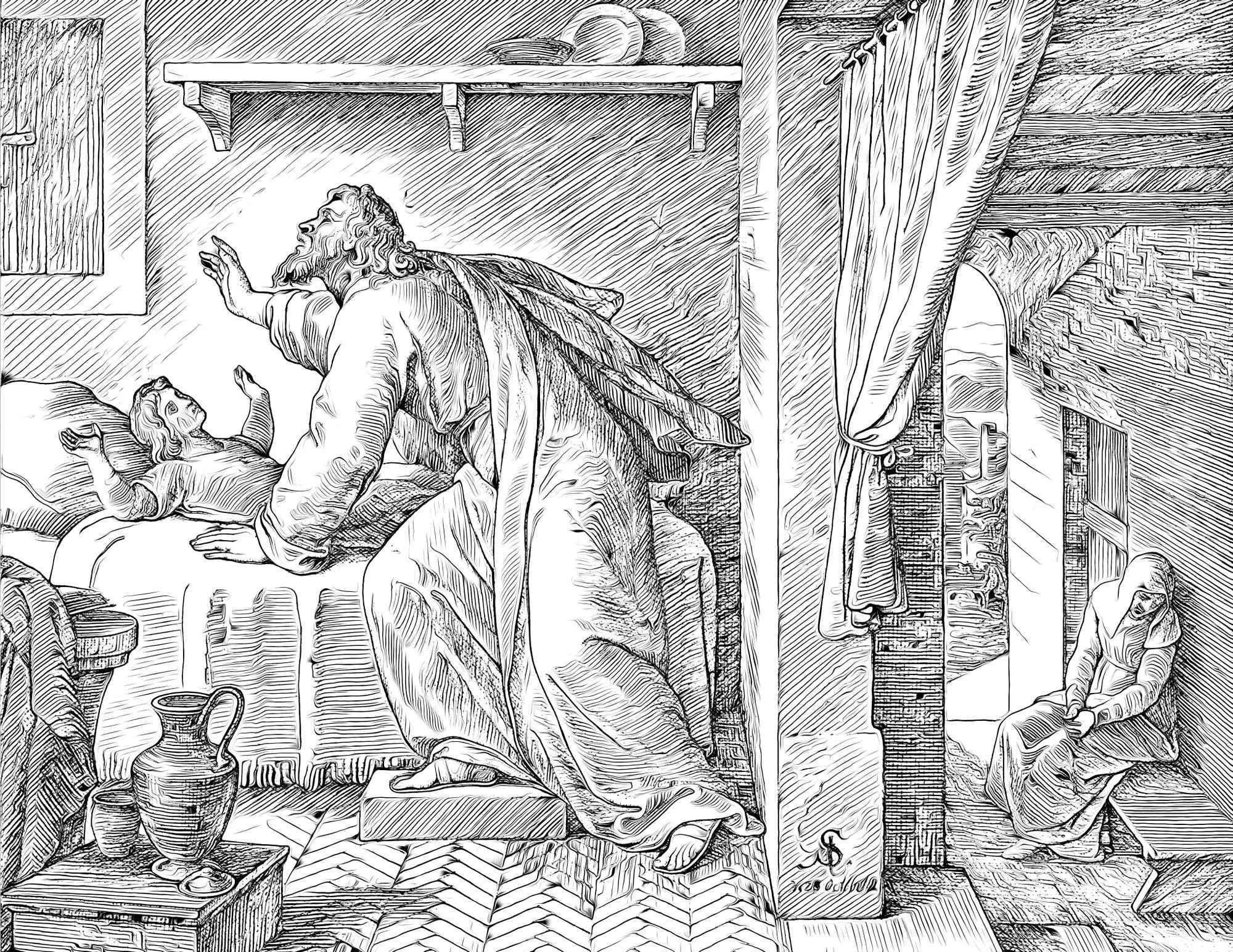
He’s dead. Her little boy. All she had. She’s a widow. What’s more, she’s a widow who trusted in God. She listened to His prophet Elijah.
Last week, we heard how Elijah came to her in the midst of a famine. She was literally preparing her last supper, her and the little boy. But at the Word of God’s prophet, the jug of oil did not run out, and the jar of flour did not empty. They survived the famine. Only for this to now happen.
This widow, the widow of Zarephath, blames Elijah – and in doing so blames herself:
“What have you against me, O man of God! You have come to me to bring my sin to remembrance and to cause the death of my son!”
Is she wrong? The wages of sin is death. We don’t know what causes this death or that disaster, but sin is at the bottom of all the world’s corruption. Anyone with a conscience finds it quite natural to believe, in the time of trouble, that his own sin is the cause.
Was there something particular in her life that was hidden? Something she didn’t want exposed? What about you? If we went through your phone, what would we find? If we audited your whispers, what would we discover? Here’s the truth: having your secrets splashed on the internet should be the least of your worries. God knows. The angels see. Everything you’ve done is naked and exposed to the Judge. You will have to give an account to Him. “You must give an account on judgment day for every idle word you speak” [Mt 12.36 NLT].
It is in this moment of crisis, the death of her son and the arrival of Elijah, that the woman is suddenly afraid because of her sins.
“What have you against me, O man of God! You have come to me to bring my sin to remembrance and to cause the death of my son!”
God knows. He remembers.
The first thing the disciple of Jesus must do, therefore, is stop blaming others for our problems. The fault is ours. The fault is mine.
Mea culpa. It’s Latin for “through my fault.” Mea culpa is part of an old Latin prayer of confession, where the penitent acknowledges sins through my fault, my own fault, my own most grievous fault, mea maxima culpa.
The purpose of confession, whether it’s the general confession we all do at the beginning of the Divine Service, or individual confession before the pastor – the purpose is to bring our own sins to remembrance, to bring them out of the darkness into the light. Only when sin is exposed can it be properly dealt with.
The Lord Jesus says,
“And this is the condemnation, that the light has come into the world, and men loved darkness rather than light, because their deeds were evil. For everyone practicing evil hates the light and does not come to the light, lest his deeds should be exposed. But he who does the truth comes to the light, that his deeds may be clearly seen, that they have been done in God.” [Jn 3.19-21]
Come to the light. Confess who you are. Mea culpa. Bring the sin to remembrance. That’s integral to participation in the Lord’s Supper. St. Paul says, “If we would judge ourselves, we would not be judged. But when we are judged, we are chastened by the Lord, that we may not be condemned with the world” [1 Cor. 11.31f].
When we judge ourselves, when we confess our sins, we bring our own deeds to remembrance.
And for this reason our Lord Jesus established another remembrance, a different remembrance. That’s the primary purpose of church, which means “assembly.” Jesus established a regular assembly, a gathering as church, around the Eucharist, the Supper. “This do,” He said, “often, in remembrance of Me.”
Now here is a mystery: The Remembrance is not simply recalling the past. It is a memory of the present and future. A memory not of what was but what is. When Jesus celebrates the Last Supper it is at the same time the First Supper, the inauguration of the Church, which is an ongoing Supper.
In this Church, the Assembly of Jesus, He remembers our sins no more, and bids us remember His coming kingdom.
That kingdom now lives in and by absolution, forgiveness, pardon. Absolution from Jesus to us, us to each other, and offered to the world.
Think of a time when you have been in conflict with your spouse, your parents, or a friend. The resolution of the conflict is often unrelated to the specific thing argued about. Rather, it is based on a remembering, a returning to what is.
“Oh. You really do love me. I forgot.”
“How could you forget? We exchanged the vows.”
Or, “Haven’t I always loved you, since you were a baby?”
Or, “Don’t you remember, how I was with you in that terrible time?”
The Christian remembering is seeing the past event as having an ongoing reality.
The forgetting wasn’t a lapse in the brain, as though a file was deleted. But other words and impressions and passions crowded in, and the memory was not so much forgotten as no longer regarded as significant.
In the Assembly, in the Eucharist, we remember.
But,
As our week goes on, things press in.
Thoughts of bills coming due, demands from others, news of new crises.
And we stumble.
Lost tempers. Weak wills. Unguarded words. Wandering eyes. Wasted time.
The memory of the kingdom fades.
“My kingdom is of this world,” we begin to believe. “And I must fight for this kingdom. It is under attack.”
The Eucharistic remembrance brings us back into the community, the communion where Jesus is at the center.
To our desires for revenge, He says, “Forgive.”
To our anxiety, He says, “Do not worry.”
To our sorrows, He says, “Do not weep.”
To our fears, He says, “Be strong and courageous.”
To our confession of sins, He says, “I do not condemn you. Go and sin no more.”
He gathers us, who may have been enemies, as His friends together. He feeds and nourishes, gives drink and gladness, and we remember. This is who I am: a disciple of Jesus, a member of His body the Church. This is who I will be: healed, free from the slavery of sin. It is not a memory of what was, but what is. And it is a memory of the future, a memory of what will be: “I look for the resurrection of the dead and the life of the world to come.”
What happened on the night of that Last Supper, which was also the First? Judas leaves the assembly. He chooses to forget. Rejecting the remembrance of Jesus, Judas rejects the kingdom, the absolution. He wants instead the silver. So he leaves the Supper, he leaves Jesus and the disciples, and goes out into the night. He chooses to forget. And this forgetting culminates in death.
That is the mortal struggle going on within each of us. Our hearts, our flesh bid us forget the Word and way of Jesus, and instead give ourselves over to the lust of the flesh, the lust of the eyes, and the pride of life.
So we gather together around Jesus and His Word, Jesus and His Supper, and remember. We remember Him, and He is present, shattering our pride and consoling our grief. He causes us to remember the present and future kingdom. His kingdom is better than the best of our current joys. In His kingdom our worst sorrows are remembered no more.
Be of good cheer, and remember:
Your sins are forgotten. You have friends among the fellow forgiven. And you are remembered by the One who will never leave you nor forsake you. +INJ+