Oculi 2026
Oculi
St. Luke 11:14-28
March 8, 2026
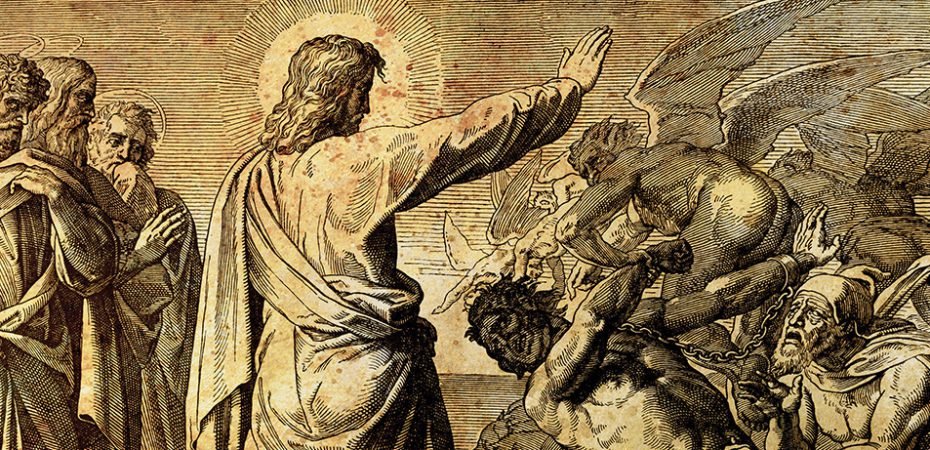
The house must be furnished. That’s the takeaway from Jesus’ teaching about exorcism. The house must be furnished.
Today’s Gospel features the little parable of the strong man. The strong man is Satan, the prince of the demons. The world is in his thrall. Man embraces his rebellion against God and the created order.
Jesus comes to liberate, to break the spell. He strips the strong man of his defenses. The two great festivals of the church year, Christmas and the Triduum, celebrate this. The incarnation, God invades His own creation; the Paschal Mystery, Christ tramples down death by His death. He crushes the head of the ancient dragon, and stands victorious on the earth. “The glory of God is a living man,” St. Irenaeus said. Risen from the dead, Jesus is the Living Man.
You and I – we’re not living; not all the way, not as we should. Part of us yearns to return to the strong man. We’re like Lot’s wife, looking back to Sodom. Or the Israelites talking about the good food back in Egypt. We’d like a foot in both camps. Be a disciple of Jesus, but not too much. Leave a little room for a bit of hedonism.
But you cannot serve two masters. “He who is not with Me is against Me,” Jesus says to you today.
It’s one or the other.
What happened at Baptism? You’ve heard the words often: “Depart, unclean spirit, and make way for the Holy Spirit.” Today Jesus teaches about what happens when a man is freed from demonic power but does not walk in the Spirit.
“When an unclean spirit goes out of a man, he goes through dry places, seeking rest; and finding none, he says, ‘I will return to my house from which I came.’ And when he comes, he finds it swept and put in order. Then he goes and takes with him seven other spirits more wicked than himself, and they enter and dwell there; and the last state of that man is worse than the first.”
What is meant by the house “swept and put in order”? “Swept” is evident; the demons are evicted. Put in order, things are tidied up. The problem doesn’t seem immediately apparent. You have to look at what’s missing.
The house isn’t furnished. There’s no new occupant. It sits empty.
Matthew’s Gospel is helpful here. He adds an additional, clarifying word. “When [the demon returns], he finds it empty, swept, and put in order” [Mt 12.44]. The house is empty. The word our Lord uses (σχολάζω) means empty and unused; it can also have a time reference, specifically free time or leisure. The house is vacant and idle. The person is vacant and idle.
The unclean spirit was evicted, but the Holy Spirit did not make His dwelling there. So the man was vulnerable. The evil influence was not replaced. The man is not transformed. No renovation has taken place.
The house must be furnished. What does that mean in practice? How is the house furnished? We can begin with the infirm man in John 5. To him Jesus says, “See, you have been made well. Stop sinning, or something worse may happen to you” [v14, BSB]. “Stop sinning.” “Sin no more.” A cornerstone of medical ethics used to be, “First, do no harm.” That should be at the top of every day’s task list. “First, don’t sin.” It’s right there in the morning prayer. “I thank You, my heavenly Father…. I pray that You would keep me this day without sin.” The house must be furnished. We furnish it with the Commandments. We must be on guard against sin. Temptation lurks everywhere.
The house must be furnished. The vulnerable house is idle. You must not be idle. Solomon says in the Proverbs, “The idle are given entirely to desires” [21.26]. Now I know you are not idle in the things of this world. You hustle, make money, make progress, get your kids to a thousand events. But is it possible that all of this is its own kind of idleness? You are busy in the lower things, as to some degree you must. Yet Gregory the Great says our souls are “wounded by the hunger of desire for lower things” [Pastoral Rule 3.15]. Seeking those things, we are idle in the pursuit of higher things. Disciplined prayer, discipline in food and alcohol, disciplined Scripture meditation – well, perhaps we’ll get to that someday, when we have more time.
And in this spiritual idleness, we allow our houses to be furnished with things ordinary and debased.
Some of the men in our congregation are doing a new program called Memento. There are daily disciplines like Bible reading and abstinence from alcohol. When I was looking through the disciplines for the different tiers, one of them came out of the blue: “Only listen to spiritually edifying music.” I thought, “This doesn’t apply to me. Everything I listen to is awesome.” But is it positively edifying? Does it draw me closer to Christ?
What are we letting into our ears? What are we letting into our minds? What are letting into our homes? The word for “put in order” is κοσμέω; it comes from kosmos, the well-ordered world; but we get cosmetics from this - make up, adornments, hangings, decorations. You can tell a lot about a person by what’s hanging on his walls. How is your house furnished? And then, what’s adorning the walls of your mind? What images are you gazing upon, burning into your mind?
“The idle are given entirely to desires.” So our house must not be idle. The house must be furnished.
The house of the disciple of Jesus is furnished with the Word of God. “Blessed are those who hear the Word of God and keep it!” By daily prayer and Scripture reading, out loud, the house is filled with the new Master, Christ, the Word made flesh.
The goal, then, is to merge our own house with the Father’s house. Here is a paradox: becoming mature is returning to childhood. Jesus says this about conversion, in Mt. 18: “Assuredly, I say to you, unless you are converted and become as little children, you will by no means enter the kingdom of heaven” [v3]. The German theologian Joachim Jeremias puts it this way:
‘Become a child again’ means: to learn to say ’Abbā again.
This brings us to the heart of the meaning of repentance. Repentance means learning to say ’Abbā again, putting one’s whole trust in the heavenly Father, returning to the Father’s house and the Father’s arms…. The repentance of the lost son consists in his finding his way home to his father. In the last resort, repentance is simply trusting in the grace of God. [New Testament Theology, 156]
The house must be furnished. We cannot stand idle. We cannot serve two masters. The house must be furnished. We furnish our house by making it not our own, but our Father’s house. The cross of His Son is on the wall of every room. The wind of His Spirit blows through, sweeping out every evil influence.
What is left is love, forgiveness, the Law and the Promises, the hope of the resurrection, the joy of edifying music, the daily bread of meals shared with family and received with thanksgiving. Our homes and hearts made ready to receive the Lord Jesus on the Day of His Judgment, when He sets all things aright. Dear Christian, go from this house to your own, and furnish it with the lordship of Jesus.
+INJ+