The Passion according to St. Luke, Part Three
Vespers, Lent III
The Passion According to St. Luke, Part Three
Luke 23:1-25
March 11, 2026
It’s disturbing to discover everything is rigged. Naïve, you thought physicians and teachers and media and politicians and pastors told the truth. One day you realize so much is a lie.
This isn’t a new problem. “All men are liars,” the Bible says. Adam blames Eve, Cain implies he doesn’t know where Abel is.
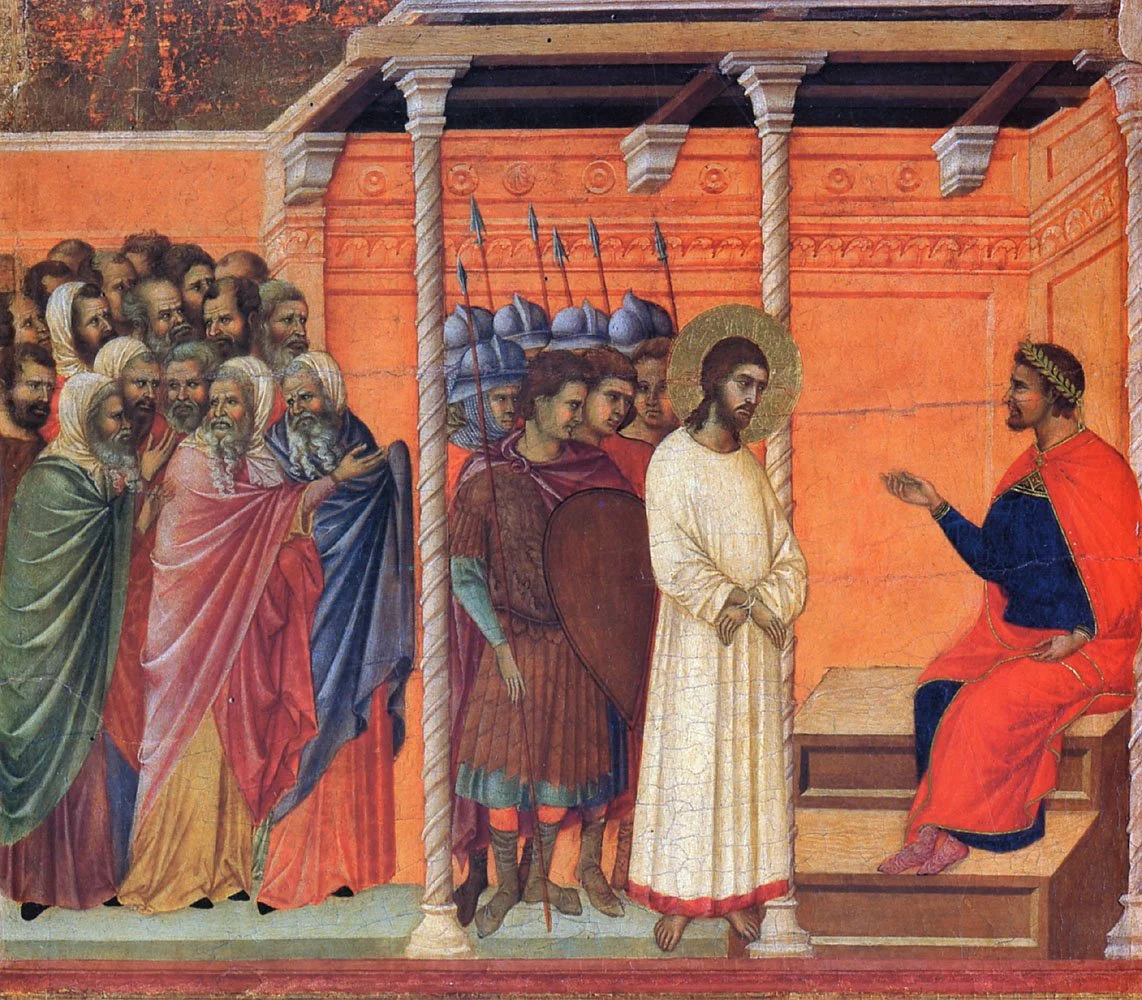
There stands Jesus before Pilate. False witnesses rise up, saying Jesus forbade them to pay taxes. He said the opposite: “Render unto Caesar what is Caesar’s.” But this will work, so the truth doesn’t matter. The accusation threatens Pilate. They make it an issue with Rome, when until three minutes ago they were furious that Jesus would eat with the collectors of these same taxes.
The truth doesn’t matter. Only power.
How is it with you? Does the truth matter? Do you speak it with love?
Jesus is accused of “perverting the nation.” This is another inversion of His own accusation against the people as a “faithless and perverse generation” [Mt 17:17]. These words are drawn from the Song of Moses in Deuteronomy: “They have corrupted themselves; They are not His children, Because of their blemish: A perverse and crooked generation” [v5]. We live, if possible, in more perverse times, when the natural order of man and woman is overturned, men doing with men shameful things, children slaughtered in utero, while criminals go unpunished.
But you disciples of Jesus, your conduct is to be wholly different from the world. St. Paul says, “Do all things without complaining and disputing, that you may become blameless and harmless, children of God without fault in the midst of a crooked and perverse generation, among whom you shine as lights in the world, holding fast the word of life” [Php 2:14–16].
Christ does not pervert the nation. He calls us out of the perversion, and would heal our nation if we would hearken to His voice.
Pilate did not listen to the voice of Jesus. He did not listen to the voice of his own conscience, nor the warning from his wife. Instead, he cowered in fear of the crowd. They were stirred up to call for Barabbas.
He’s often described, like the men crucified with Jesus, as a “robber.” This translation is weak. He is part of a rebel movement seeking to drive out the Romans. It’s Luke’s Gospel that tells us why Barabbas is in prison: “For a certain rebellion made in the city, and for murder.”
Barabbas is Aramaic for “son of the father.” The irony here is rich: the real Son of the Father, they reject, while embracing the rebel, who, like them, is of their father the devil.
There is more happening here than the political concerns of first-century Judea and their Roman occupiers. This is the story of mankind. We embraced the rebel, and rejected the Redeemer.
And every time you set aside the commandments of God – every time you succumb to weakness, every time you gaze on what is unholy, every time you pass on gossip, every time you complain about your situation, you reject Jesus: “Not this man, but Barabbas!” You choose rebellion.
Repent. Leave the perversion, leave the rebellion. Return to the Lord, and He will pardon you abundantly.
Luke tells us tonight, “The voices of these men … prevailed.” Don’t let them prevail against you. Don’t let them prevail in you. You are not a slave to your passions. You are not a slave to your desires. You are not a slave to your past actions. You have received the Holy Spirit. You are baptized.
Now here is something astounding beyond measure: In swapping Jesus for Barabbas, the rebel is released. God Himself receives the rebel’s punishment. This is His will, that you might likewise be released, that all rebels might be pardoned.
The lot that fell on Jonah, the lot that fell on you, proclaiming your guilt, Jesus accepts. You are free. Jesus becomes the rebel, and you become the innocent one.
+INJ+