The Passion according to St. Luke, Part Four
Vespers, Lent IV
The Passion according to St. Luke, Part Four
Luke 23:26-56
March 18, 2026
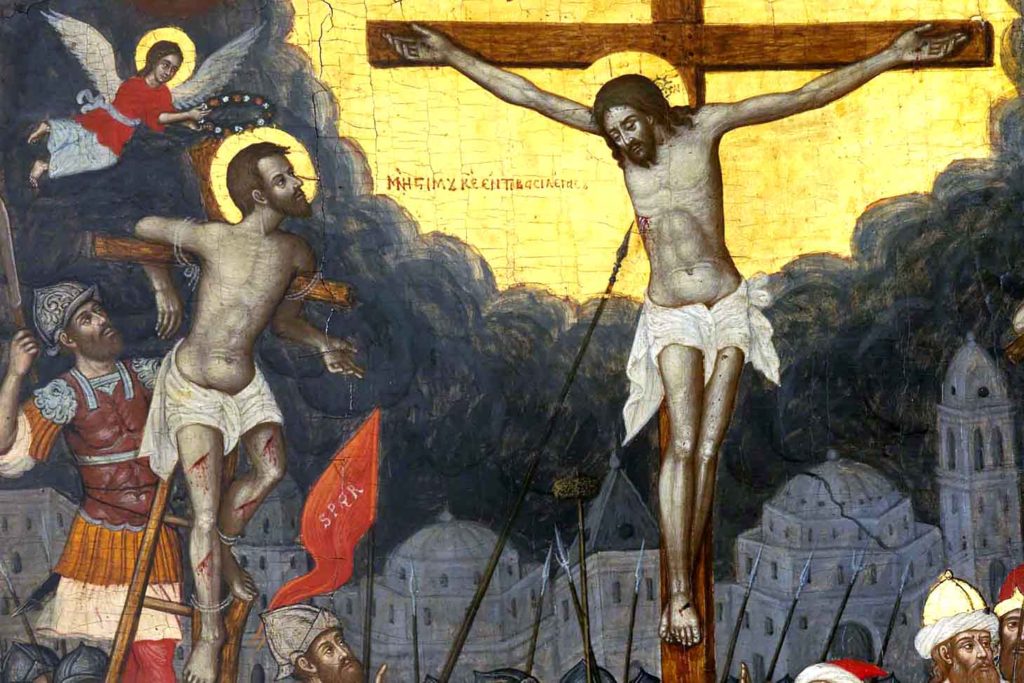
The so-called thief on the cross is called a criminal in Luke’s Gospel. Other gospels use a word for rebels, violent insurrectionists. In Luke, he is a κακοῦργος - evil-doer, malefactor.
One of these criminals mocks Jesus. The other, whom tradition names Dismas, has been observing Jesus. It has changed him.
He responds. Not only with rebuke. He confesses. “We are condemned. And our condemnation is just. But this One – He has done nothing out of place.”
This is nothing short of remarkable. Everything in him has changed through the encounter with the crucified Jesus. His entire worldview is different.
He ended up on this cross because he sought a kingdom where Jews reigned and Romans were driven out. It was a kingdom with armies, a palace, a place, a king.
Now he says to the dying Jesus, “Lord, remember me when You come into Your kingdom.” He sees Jesus dying. He now confesses a different kind of kingdom.
His righteous cause he now calls unrighteous. Jesus is Lord. He sees it now.
And Jesus promises him Paradise. This word only appears three times in the NT. It refers to a kind of garden or park that is an intermediate place between death and resurrection.
The NT teaches us that when a disciple of Jesus dies, his body returns to the earth, while the soul is “with the Lord” in this in-between place. It is beautiful and peaceful—it is paradise—but it is not yet the fullness of the kingdom. That comes in the resurrection.
Jesus promises the malefactor an immediate translation to this paradise. There is no purgatory, God’s Word nowhere teaches that.
But God’s Word does teach us about things like Baptism and the other means of grace. And our thief on the cross is often cited as the reason why all the other things Jesus taught aren’t important. After all, the thief on the cross wasn’t baptized, never received the Lord’s Supper, and here he is going straight to Paradise.
There’s a legal maxim, “Hard cases make bad law.” The thief on the cross isn’t a hard case, but it is unique. We don’t take a unique situation and make a general rule out of it. We could say unique cases make bad law, or in this case, bad theology.
But it’s precisely the uniqueness of the situation that helps us to understand how the means of grace work. The thief on the cross isn’t the exception. He shows what the means of grace do for us.
We are not on crosses next to Jesus. Although we deserve it. In a sense, this is the most blessed position to be in. This criminal gets to appeal directly to Jesus. We cannot do this, not in the local sense of seeing Jesus, hearing His audible speech, perhaps even being splattered by His blood.
But this criminal, he can confess directly, immediately, to Jesus. And He hears what is effectively an absolution: “Today you will be with Me in Paradise.”
We who are separated by time and space, cannot directly hear this Word. So we come to Jesus at Holy Baptism in a mediated way. We do not see Jesus directly. All that the mortal eye beholds is water as we pour it. But to the eye of faith unfolds the power of Jesus’ merit. Faith beholds the crimson flood, the flood which the criminal with Jesus saw directly. There at Baptism, and at Holy Absolution, and at Holy Communion, we receive what the Lord Jesus gives. We come with contrition, saying, “I am the criminal, I deserve that death.” And Absolution and Communion is Jesus saying to us, “You will be with me in My Kingdom.” What the criminal heard directly, we get indirectly. What the criminal heard immediately, we hear mediated through the Word and Sacraments. That’s why Jesus established them – He wants us to hear His forgiveness, be joined to Him in His death, so we can know and trust and hope and be glad.
Come therefore to the means of grace as the malefactor. Confess your just judgment, that you deserve the cross. Implore Jesus to remember you. Receive in Absolution and Supper His response: “I forgive you. You shall be with Me in Paradise.”
+INJ+