Laetare 2026
Laetare
St. John 6:1-15
March 15, 2026
In the beginning, food was free. Eden was all-inclusive.
The fall of the human race changed our relationship with food. “By the sweat of your brow you shall eat bread” [Gen 3.19]. Tilling, planting, watering, protecting, harvesting, grinding, baking – a single loaf of bread requires a year of labor. And some years—by fire, flood, or drought—it’s all ruined. “Cursed is the ground for thy sake,” the Lord tells Adam; “in sorrow shalt thou eat of it” [Gen 3.17].
Bread is both blessing and curse. Food is blessing, but the labor in thorny fields is curse.
Bread expands to mean all food. The Catechism picks up this theme: “Daily bread includes everything that has to do with the support and needs of the body.” The big earner in a family is the breadwinner. Bread becomes slang for money, along with dough.
Bread spoils. The bread from heaven—manna—seems designed to spoil. Moses told the people, “Don’t collect more than you need.” They didn’t listen. The next morning it stank, and was infested with maggots!
“Maggot sack” was a medieval metaphor for man. We go back to the ground. People try to avoid this by purchasing expensive sealed vaults and liners. It only delays the inevitable. The bugs and the water will win. You cannot escape it.
Luther once called the emperor “that poor mortal maggot sack … who is not certain of his life for a single moment” [LW 59 p95]. His point was the exalted rulers can suddenly die, and they cannot truly defend us. At that time, the Ottoman Empire was the great military threat. But Luther saw this in theological terms. The forces of Islam were attacking, and this, he believed, was divine judgment, because the Holy Roman Empire, and the Pope, placed their trust in money and arms, not the Word of God. To place your trust in horses or men—that is, to place your trust in armies—is to trust in maggot sacks.
But the term “maggot sack” Luther turned also on himself. Without God’s grace, the whole human race is fragile, worthless, worm food. The crude image is intended to shock. Soon, soon, life is over, and there is no pest control six feet under.
But see how God uses the maggots as an object lesson for the Sabbath, and for His power over nature. For six days, any leftover bread became infested with maggots; but on Friday, the extra collected for the Sabbath remained preserved and unspoiled.
The laws of nature are subject to Him who wrote them. He can preserve the bread. He can raise the dead.
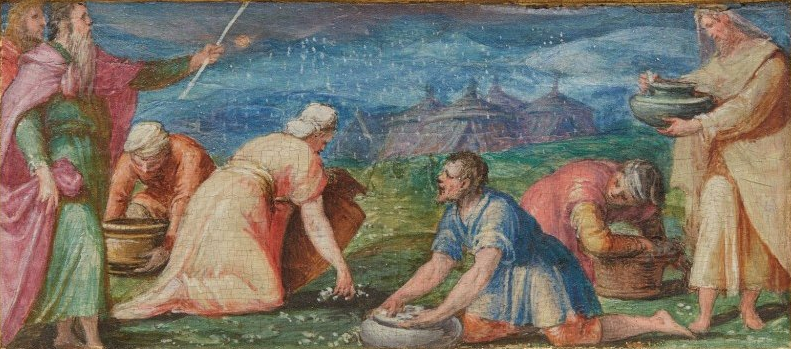
The entire episode is teaching them that God gives daily bread. You can save all you want, but you cannot provide for tomorrow. Only God can.
“You fool!” God says to the man who builds bigger barns. “Tonight your life is demanded of you. What then will come of all the bread in your barns?”
I’ve always thought the 200 denarii in today’s Gospel was an estimate. Jesus asks where they will buy bread for the crowd. Philip answers, “Two hundred denarii worth of bread is not sufficient for them, that every one of them may have a little.” But it might not be an estimate. It might be what they have in their treasury. A denarius is a day’s wage for a laborer; 200 denarii is between $10,000 and $20,000. Philip may be saying, “We could spend everything we have, but it won’t buy much food, and then we’ll be broke.”
And there’s the problem – for disciples then and now. Our calculations lack faith. God allows the worms – or drives them away. He kills and He makes alive.
Jesus doesn’t need the money. He can get more from the mouths of fish.
But He does want us to loosen our stranglehold on it – as if by clinging to our treasure we can secure our future. Where your treasure is, there your heart shall be also.
Hoarded, our stash will, like the manna, breed maggots and stink. Placed into His hands, the good things multiply. So our Lord Jesus Christ takes bread, blesses it, and gives it to the disciples. And they give it to the crowd. And it is enough.
The crowd misunderstands the lesson. They would make Jesus king by force. Their thoughts are on the political possibilities of this meal ticket messiah.
Jesus withdraws. The next day they find Him. And He says to them,
“Most assuredly, I say to you, you seek Me, not because you saw the signs, but because you ate of the loaves and were filled. Do not labor for the food which perishes, but for the food which endures to everlasting life, which the Son of Man will give you, because God the Father has set His seal on Him.”
Then they said to Him, “What shall we do, that we may work the works of God?”
Jesus … said …, “This is the work of God, that you believe in Him whom He sent.”
The evangelical-catholic faith of the Reformation was right; we are not justified by works, but by faith in Jesus. But that’s not the main point here. The crowd is still trying to secure their future according to the terms of the fall. They’re looking for bread among the thorns. They’re looking for the bread that grows maggots, they’re looking for money that cannot secure their future, they’re looking for pleasure for bodies that soon die.
Jesus tells them, “Your priorities are wrong.” “Do not labor for the food which perishes.”
This morning, He says the same to you.
For what are you laboring? On what are you wasting your dough? What future do you think you are securing? 200 denarii won’t be enough. Two million won’t be enough. It is never enough. It all breeds worms and stinks.
There’s only one way out. Jesus says,
“I am the bread of life. Your fathers ate the manna in the wilderness, and are dead. This is the bread which comes down from heaven, that one may eat of it and not die. I am the living bread which came down from heaven. If anyone eats of this bread, he will live forever; and the bread that I shall give is My flesh, which I shall give for the life of the world.”
Man does not live by bread alone. You live by the Word of God. The Word, joined to this bread, saves.
Stop working for what perishes. Invest in what is eternal. Live by what God commands. Live by what God promises. Live for the resurrection.
When you look around and see all that is worthless, do not despair. Resurrection is coming.
+INJ+